Dealing with Poor Soil and Compaction in Older Houston Neighborhoods
If you’ve been gardening or landscaping in an older Houston neighborhood — places like Garden Oaks, Meyerland, or Oak Forest — you’ve probably noticed that the ground can feel more like concrete than soil, especially after a hot, dry summer. Plants struggle to take root, water pools in low spots instead of soaking in, and even healthy grass starts thinning out for no obvious reason. The culprit is often compacted, clay-heavy soil — one of the most common and overlooked challenges in Greater Houston’s established neighborhoods.
Houston’s natural soil is predominantly expansive clay, and in older, built-up areas, decades of foot traffic, vehicle weight, construction activity, and lack of organic matter leave the ground severely compacted. The good news is that these problems are correctable. At Danny’s Landscaping, we’ve been working with Greater Houston’s soil conditions for over 30 years, and we know exactly what it takes to bring struggling landscapes back to life.
Why Houston’s Soil Becomes Compacted Over Time
Houston sits in USDA Hardiness Zones 9a and 9b, on a flat coastal plain built largely on heavy, expansive clay. This soil type — sometimes called “Houston Black” or “Beaumont clay” — is notorious for its ability to swell when wet and shrink and harden when dry. In older, established neighborhoods, this natural challenge is compounded by years of accumulated use.
Compaction happens when soil particles are pressed tightly together, reducing the pore space that roots, water, and air need to move freely. The result is a hard, dense layer — often called hardpan — that sits just a few inches below the surface. When rainwater hits compacted clay, it has nowhere to go. It either pools on the surface or runs off, taking topsoil with it. Roots hit the hardpan layer and spread laterally instead of downward, leaving plants and turf shallow-rooted and vulnerable to heat stress and drought.
In older Houston neighborhoods, this process has been building for decades. Trees whose roots once broke up the soil have been removed. Driveways and patios have redirected water across lawn areas. Lawn maintenance equipment, delivery vehicles, and construction projects in neighboring properties all add to the compaction problem year after year. The older the neighborhood, often the more deeply entrenched the soil issues become.
Houston’s Climate Makes Compaction Worse
Greater Houston’s Gulf Coast climate creates a uniquely punishing cycle for compacted soil. Summers routinely push temperatures above 90°F, baking clay into near-brick-like hardness. Then, when Gulf moisture brings heavy rainfall — or a named storm moves through during hurricane season (June through November) — that same hardened clay can’t absorb water fast enough, leading to standing water and flash flooding.
Homeowners along Brays Bayou, near Addicks and Barker Reservoirs, and throughout low-lying neighborhoods in the Energy Corridor have seen firsthand what happens when compacted soil and inadequate drainage collide. Water doesn’t move, roots suffocate, and lawns that looked fine in April can be a soggy, dying mess by September.
In neighborhoods like Bellaire, West University Place, and Friendswood, where many homes sit on decades-old landscaping, the soil near foundations, driveways, and established trees is often the worst. Heavy vehicles from utility companies, HVAC contractors, and previous construction projects leave behind compaction that no amount of watering or fertilizer can fix on its own. The soil itself needs to be addressed before any real improvement in plant health or lawn performance can take hold.
Cypress and Katy homeowners along the I-10 corridor deal with a slightly different but related challenge — large areas of fill soil brought in during development that, over time, compresses and settles unevenly, creating a mix of compaction and grading issues that affect both drainage and planting success.
Practical Solutions for Compacted Soil in Houston Landscapes
The right approach depends on the severity of the compaction, the age of the landscape, and what you’re trying to grow. Here are the most effective solutions Houston homeowners can use:
- Core Aeration Core aeration removes small plugs of soil from the lawn, creating channels for air, water, and nutrients to penetrate the hardpan layer. In Houston’s clay-heavy soil, aeration should ideally be done in the fall — September through November — when soil moisture levels are more manageable. For heavily compacted lawns, one round of aeration may not be enough; plan for it as an annual or semi-annual practice.
- Topdressing with Compost or Sandy Loam After aeration, spreading a thin layer (¼ to ½ inch) of quality compost or sandy loam over the lawn helps fill the aeration holes and gradually improves soil structure over time. Compost introduces beneficial microorganisms that naturally break down compacted clay. This is a slow process, but consistent topdressing over two to three seasons produces measurable improvement in soil texture and drainage.
- Deep-Till and Soil Amendment for New Beds For garden beds or areas where you’re starting fresh — removing old plants, replanting, or installing a new landscape — deep tilling to a depth of 8 to 12 inches combined with generous organic amendment is the most effective way to reset the soil. Incorporate 3 to 4 inches of compost, aged wood chips, or expanded shale into the native clay. Expanded shale, in particular, is excellent in Houston landscapes because it permanently improves drainage and aeration without breaking down over time.
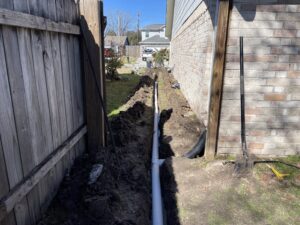
- French Drains and Surface Grading If standing water is part of the problem — as it often is in older Houston neighborhoods — soil amendment alone won’t solve everything. Proper grading and, where needed, subsurface drainage solutions like French drains redirect water away from compacted areas before it can cause pooling or root damage. Addressing drainage and soil health together produces far better long-term results than tackling either in isolation.
- Mulching Applying 2 to 3 inches of organic mulch around trees, shrubs, and garden beds protects the soil surface, retains moisture, moderates temperature extremes, and gradually improves soil structure as it breaks down. In older neighborhoods where mature trees are present, keeping mulch over the root zones reduces the compaction caused by foot traffic and mowing.
- Choosing the Right Plants Not every Houston landscape can be completely remediated overnight. In the meantime, selecting plants that tolerate heavy clay and moisture fluctuation makes a real difference. Native and adapted species like Gulf muhly grass, inland sea oats, turk’s cap, yaupon holly, and dwarf palmetto perform well in Houston’s challenging soil conditions while you work on long-term improvement.
When It’s Time to Call a Professional
Some soil problems go beyond what a bag of compost and a rented aerator can fix. If you’re dealing with severe compaction across large areas, persistent standing water after every rain, failing turf despite regular care, or a landscape renovation that requires grading work near your foundation or hardscaping — that’s where professional assessment makes a significant difference.
At Danny’s Landscaping, we’ve worked with Houston-area homeowners for over 30 years, from Memorial and River Oaks to Pearland, Sugar Land, and The Woodlands. We understand how Houston’s clay soil behaves across different neighborhoods, soil types, and drainage situations. We don’t offer one-size-fits-all solutions — we take the time to evaluate your specific property, identify the root causes of your soil and drainage challenges, and design a practical plan that fits your goals and budget.
Our transparent four-step process means you’ll know exactly what we’re recommending, why we’re recommending it, and what it will cost before any work begins. No surprises, no pressure — just honest, experienced guidance from a local team that genuinely cares about your property.
If your lawn or landscape has been struggling despite your best efforts, we’d be happy to take a look. Reach out to schedule your free consultation — there’s no obligation, and sometimes a fresh set of experienced eyes is all it takes to find the right path forward.
📞 (713) 514-3537 ✉️ da***@*****************tx.com
[CTA BLOCK]
Whether you’re in an older neighborhood near Buffalo Bayou or a more recently developed community out along the Grand Parkway in Katy or Cypress, Houston’s clay soil doesn’t have to hold your landscape back. Danny’s Landscaping has been helping Greater Houston homeowners and businesses build healthier, more functional outdoor spaces for over 30 years — and we’d love to help you do the same. Give us a call at (713) 514-3537 or send us a message to schedule your free property assessment. We’re always happy to take a look and talk through your options, no pressure and no obligation.
[FAQ SECTION]
Q: How do I know if my Houston lawn has compacted soil? A: The most common signs include water pooling on the surface after rain, grass that looks thin or patchy despite regular watering, and soil that feels rock-hard when you try to push a screwdriver or flag stake into it. In older Houston neighborhoods with heavy clay, compaction is very common and often builds gradually over many years without obvious signs until plant health starts to noticeably decline.
Q: What is the best way to fix compacted clay soil in Houston? A: The most effective long-term approach in Houston combines core aeration, topdressing with quality compost or expanded shale, and consistent organic mulching over several seasons. For severely compacted areas or new planting beds, deep tilling and soil amendment provide a faster reset. If standing water is also a problem, grading and drainage improvements should be addressed at the same time for the best results.
Q: When is the best time to aerate a lawn in Houston, TX? A: Fall — typically September through November — is generally the best window for aerating Houston lawns. The extreme summer heat has passed, soil moisture is more consistent, and warm-season grasses like St. Augustine and Bermuda are still active enough to recover and fill in before going dormant. Spring aeration can also be beneficial, though Houston’s spring rainfall can make timing tricky.
Q: Can I add topsoil or compost on top of my existing Houston lawn to improve the soil? A: Yes, topdressing with a thin layer (¼ to ½ inch) of quality compost or sandy loam is an effective way to gradually improve heavy clay soil without removing your existing lawn. It works best when done after aeration so the material can filter into the soil profile. Done consistently over time, it meaningfully improves soil texture, drainage, and overall plant health.
Q: Does poor soil drainage in Houston cause foundation problems? A: It can contribute to them. Houston’s expansive clay soil swells when wet and shrinks when dry, and poor drainage that keeps soil consistently saturated — or allows extreme wet-dry cycles — can stress foundations over time. Proper grading that directs water away from the home, combined with healthy soil that absorbs rainfall more efficiently, is a smart investment for both landscape health and long-term property care. If you have concerns about drainage near your foundation, a professional assessment is a worthwhile step.